Blog

  • The AGI Moment Is Here. What It Means for Marketing Leaders

    The AGI Moment Is Here. What It Means for Marketing Leaders

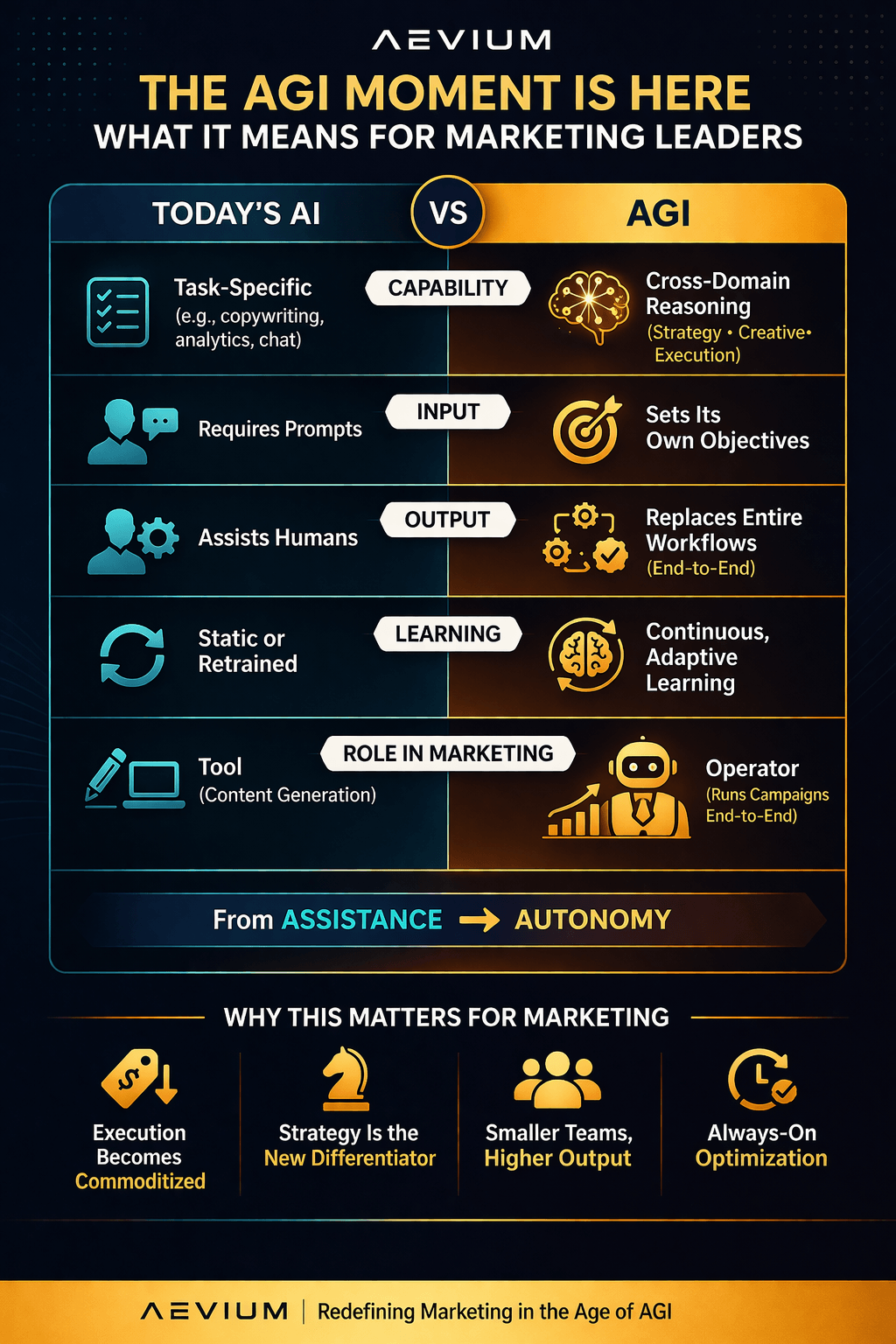
    Artificial General Intelligence is no longer a distant concept. For years, AGI was positioned as something on the horizon, a future milestone that businesses could afford to watch rather than prepare for. Today, that framing is beginning to shift, and the conversation around AGI in marketing is becoming more immediate.

    When Jensen Huang, CEO of NVIDIA, suggested that we may have already reached a form of AGI, it did more than spark debate. It signaled a change in urgency. Whether or not one agrees with that definition, the implication is clear. Artificial intelligence is no longer just improving tools. It is starting to reshape how work itself is executed.

    From AI Tools to Autonomous Systems

    Up until now, AI has primarily functioned as an enabler. It has accelerated execution, reduced costs, and improved efficiency, but it has remained dependent on human direction. The responsibility for thinking, judgment, and orchestration has stayed with people.

    That boundary is now being tested.

    We are entering a phase where AI systems are beginning to move beyond task execution into reasoning. These systems can connect information across domains, make decisions, and carry initiatives forward with limited oversight. This transition from assistance to autonomy has significant implications for marketing as a discipline and reinforces why AGI in marketing is becoming a critical focus.

    The Impact of AGI in Marketing on Agencies

    For marketing agencies, the shift is structural. Execution, which has traditionally been a core revenue driver, is becoming increasingly automated. As a result, its perceived value is declining. At the same time, strategic thinking is becoming more critical.

    Positioning, market understanding, and the ability to define the right problems are emerging as the primary sources of differentiation.

    This evolution will likely reshape agency models. Smaller, more focused teams will be able to deliver greater output by leveraging AI-driven workflows. The gap between organizations that understand how to integrate these systems effectively and those that do not will widen. Agencies will move closer to business strategy, playing a more central role in decision-making rather than focusing primarily on campaign execution.

    How AGI in Marketing Is Changing Client Expectations

    Clients are undergoing a similar transformation. As AI capabilities become more accessible, internal teams are gaining the ability to take on work that was previously outsourced. Expectations around speed and responsiveness are increasing, and traditional timelines are being compressed.

    What once felt fast will soon feel slow.

    In parallel, data is becoming an even more important competitive asset. The effectiveness of AI systems will depend heavily on the quality and structure of the data they are built on. This is where AGI in marketing will create the biggest divide between organizations.

    Decision-making processes are also evolving. As AI systems become more capable, they are starting to influence not only execution but also optimization and strategic choices. Budget allocation, channel selection, and performance optimization are increasingly informed by AI-driven insights. This does not eliminate the need for human judgment, but it does redefine where that judgment adds the most value.

    The more relevant question for marketing leaders is no longer how to use AI tools.

    It is how to operate in an environment where execution is no longer the primary constraint.

    Artificial General Intelligence, whether fully realized or still developing, is already influencing expectations across the industry. In marketing, expectations directly impact perceived value, pricing models, and competitive positioning.

    Organizations that adapt successfully will not be those that simply adopt new technologies. They will be the ones that rethink their operating models, redefine their value proposition, and align their capabilities with a more autonomous, AI-driven landscape.

    That shift is already underway.

    The impact of AGI in marketing is only beginning, and those who adapt early will define what comes next.

    If you’ve read this far, I’m curious where you stand on this.

    Do you believe AGI is already here, or are we still early?

    And more importantly, how are you thinking about your role as this shift unfolds?

    Curious to hear your perspective. If this resonated, feel free to like or share so more people in the industry can weigh in.
  • Conscious Marketing: Why I Believe Marketing Needs to Evolve

    Conscious Marketing: Why I Believe Marketing Needs to Evolve

    I’ve spent more than two decades working in marketing. During that time, I’ve had the opportunity to work across different markets, industries, and brands, from global companies to growing businesses trying to find their place in the market. Over the years, one thing became very clear to me: marketing is incredibly powerful. It shapes how people think about products, how brands position themselves, and ultimately how consumers make decisions. Sometimes it even convinces us we urgently need things we didn’t know existed five minutes ago.

    But recently I’ve found myself thinking more and more about a question that I don’t think our industry asks often enough. Is the way we approach marketing today still aligned with the world we live in? Because if we’re being honest, much of the marketing system we operate in was built for a very different era.

    Marketing Was Born in a Different Economic Reality

    To understand where we are today, it helps to look at where marketing came from. Modern marketing as we know it largely emerged during the industrial expansion of the late 19th and early 20th centuries. As factories became capable of producing goods at unprecedented scale, companies suddenly faced a new challenge. The problem was no longer how to produce products. The problem became how to sell them… and preferably a lot of them. That’s where marketing stepped in.

    Advertising, branding, and promotional campaigns became essential tools for creating demand and moving products through increasingly competitive markets. In many ways, marketing was born inside the rapid rise of industrial capitalism, and naturally the priorities of that system shaped the priorities of marketing.

    The focus was clear: produce more, sell more, grow faster. Consumer well-being, environmental impact, or long-term societal consequences were rarely part of the conversation at the time. That doesn’t mean the industry was intentionally harmful, but historically speaking, the system rewarded companies that could generate the most demand and revenue. Over time, regulations improved product safety, consumer protections became stronger, and public awareness increased. But the underlying incentive structure of marketing largely remained the same.

    The World Has Changed; But Marketing Hasn’t Fully Caught Up

    Today we live in a completely different environment. Consumers are more informed than ever. Information travels instantly. People research companies, investigate supply chains, and openly discuss brand behavior online. At the same time, awareness around issues like environmental sustainability, social responsibility, and corporate accountability has grown dramatically. People increasingly care about the impact businesses have on the world around them.

    And yet, much of marketing still operates according to assumptions developed more than a century ago. We still measure success primarily through short-term metrics: clicks, conversions, campaign performance, and quarterly sales spikes. All important metrics, of course, but sometimes it feels like the industry is optimizing for the next quarter while the world outside is thinking about the next decade. After spending more than 20 years in this industry, I’ve started to believe that marketing needs to evolve in the same way the world around it has.

    Introducing the Idea of Conscious Marketing

    This is where a concept I’ve been thinking about comes in. I call it Conscious Marketing.

    At its core, Conscious Marketing is about redefining the role marketing plays in business. Instead of focusing purely on driving consumption and maximizing short-term revenue, Conscious Marketing focuses on creating value while respecting consumers, communities, and the environment. It recognizes that marketing is not just a tool for persuasion. It is a force that influences culture, consumer behavior, and economic systems.

    So the questions we ask as marketers should evolve. Instead of only asking “How do we sell more?”, we should also be asking whether we are communicating honestly with consumers, whether we are helping people make informed decisions, whether we are building long-term trust rather than short-term transactions, and whether we are considering the broader impact of what we promote.

    Conscious Marketing doesn’t reject growth. Businesses still need to grow. But it argues that growth should be responsible, transparent, and sustainable. And let’s be honest, if marketing didn’t evolve, at some point AI could just start selling things directly to humans without the pretense of ethics anyway. Better to lead than be replaced by a robot, right?

    Why This Shift Is Happening

    Interestingly, I don’t think this shift is being driven by marketers themselves. It’s being driven by consumers. People today are far more conscious about the choices they make and the brands they support. They care about things like environmental impact, ethical sourcing, corporate behavior, and transparency in communication.

    At the same time, trust in traditional advertising has declined. Consumers have become increasingly skeptical of exaggerated claims. And to be fair, they’ve had plenty of practice. Ironically, in a world where marketing tools are becoming more advanced, especially with the rise of automation and AI, authenticity and transparency are becoming more valuable than ever. Trust is starting to matter more than persuasion.

    What It Means When a Company Adopts Conscious Marketing

    When a company commits to Conscious Marketing, it sends a very clear message. It signals that the business does not view consumers simply as targets or transactions. It views them as people whose trust actually matters.

    In practical terms, a company embracing Conscious Marketing is saying that it cares about its customers, not just their purchasing power. It believes long-term trust is more valuable than short-term profit. It is committed to transparency in how it communicates. And it recognizes that businesses have responsibilities beyond revenue.

    This may sound simple, but it represents a meaningful shift in mindset. Instead of measuring success purely through short-term sales metrics, companies begin thinking about something bigger: trust, accountability, and long-term brand integrity.

    Conscious Marketing as a Signal of Responsibility

    Today many companies proudly promote their environmental initiatives or sustainability commitments. Consumers have learned to recognize signals like carbon-neutral operations, ethical sourcing, and sustainable packaging.

    Conscious Marketing could become a similar signal. When a company adopts this philosophy, it communicates something important about how it chooses to operate. It tells the market that the company is not focused solely on extracting maximum profit at any cost. Instead, it aims to build a business that respects customers, society, and the environment while still pursuing growth.

    For consumers, that creates clarity. For companies, it creates accountability. And for the marketplace as a whole, it encourages a shift toward brands that prioritize responsible growth rather than unchecked consumption.

    A New Direction for Marketing

    Marketing has always evolved alongside society. From print advertising to digital marketing, from mass media to social platforms, every era has reshaped how brands communicate with people.

    Today we may be approaching another shift. One where marketing is not defined solely by its ability to influence behavior, but also by its ability to build trust, respect consumers, and contribute positively to the world around us.

    After more than two decades in this industry, I believe this evolution is not only possible, it’s necessary. That shift is what I call Conscious Marketing, and for the businesses willing to embrace it, it may represent one of the most sustainable paths to growth in the years ahead.

    At Aevium, this is the direction I believe marketing is heading. As our industry continues to evolve, agencies and businesses alike will need to think more carefully about the role marketing plays in shaping consumer behavior and business outcomes. My hope is that Conscious Marketing becomes part of that conversation, and that more companies begin to see responsible, transparent marketing not as a limitation on growth, but as the foundation for building stronger and more trusted brands in the years ahead. And if we can do that while having a little fun along the way, convincing people to need things they didn’t know existed five minutes ago… well, maybe marketing isn’t losing its magic after all.

  • Smarter Marketing Starts Here: How Small Businesses Are Winning With AI

    Smarter Marketing Starts Here: How Small Businesses Are Winning With AI

    AI used to be the secret weapon of large enterprises with deep pockets.
    Now? It’s the growth accelerator small and midsize businesses can’t afford to ignore.

    From automating repetitive tasks to uncovering smarter insights, AI is helping business owners market more effectively, with less effort and more precision.

    But here’s the catch:
    AI isn’t a plug-and-play miracle. It’s a tool. And like any tool, it only works when used strategically.

    In this post, we’ll break down five powerful ways small businesses are using AI to market smarter, scale faster, and connect better, with real-world examples to help you start today.

    1- Workflow Automation: Save Time and Scale Faster

    AI tools can automate repetitive marketing tasks like:

    • Email follow-ups
    • Social media scheduling
    • Lead qualification
    • Weekly reporting

    This isn’t just convenient, it’s how you scale without hiring.

    2- Personalized Marketing at Scale: One-to-One, Automatically

    AI takes personalization to the next level, without the manual work. You can segment your audience, tailor content, and even auto-adjust ad creative in real-time based on customer behavior.

    Example: Platforms like Mailchimp and Klaviyo use AI to automatically personalize email content based on past purchases or website activity.

    What used to take hours now takes minutes, and performs better.

    3- AI-Powered Content Creation: Work Smarter, Not Harder

    Struggling to keep up with content demands?
    AI writing tools like Jasper or ChatGPT can help you:

    • Brainstorm blog topics
    • Generate social captions
    • Create first drafts
    • Re-purpose existing content across channels

    Pro Tip: Let AI assist with structure, ideas, and re-purposing, but keep the final voice human. That’s where the magic happens.

    Predictive Analytics: Turn Data into Direction

    AI isn’t just about automation, it’s also about insight.

    Platforms like HubSpot or Zoho CRM now use AI to:

    • Predict which leads are most likely to convert
    • Highlight the most effective channels
    • Identify the best times to engage your audience

    It’s like having a marketing analyst baked into your stack.

    AI-Powered Customer Service: Support That Never Sleeps

    AI chatbots and voice agents can now:

    • Answer FAQs
    • Book appointments
    • Provide 24/7 customer support
    • Integrate with calendars and CRMs

    Our Aevium Flow AI Receptionist helps SMBs book clients, handle customer inquiries, and sync with calendars, hands-free.

    Bottom Line: AI Is for Builders, Not Just Big Tech

    You don’t need to be a tech company to use AI.
    You just need to be intentional.

    Start with your business goal.
    Then choose AI tools that support it, not distract from it.

    The smartest businesses in 2025 won’t just be using AI.
    They’ll be building smarter systems around it, from marketing and operations to customer service.

    Want to start a Project?

  • Why Strategy Comes First in Marketing

    Why Strategy Comes First in Marketing

    If you’re not leading with strategy, you’re just making noise.

    If you’re running a small/medium or growing business, chances are you’ve been told that marketing is all about social media posts, email blasts, or throwing some budget behind ads. Those are tactics, not marketing.

    Real marketing begins long before anything is posted or promoted. It starts with strategy, understanding your audience, defining your unique value, and building a roadmap that connects your business goals to the real world.

    Without that, you’re not marketing. You’re driving blind.

    Why Strategy Comes First

    Marketing isn’t just about visibility, it’s about business growth. It should answer one foundational question:

    “What do we need to do, strategically, to achieve our business goals?”

    That’s where most small businesses slip. They jump straight to execution: designing logos, scheduling posts, boosting ads. But without a plan, even the most creative efforts lack direction and impact.

    Strategy keeps your brand consistent, your resources focused, and your message aligned.

    A Plan Before You Post

    The best-performing businesses don’t just do marketing, they plan it thoughtfully. Before launching any campaign, smart marketers walk through five key steps:

    1. Market Research
      What’s really going on in your industry or niche? Are there untapped opportunities or trends you can own?
    2. Audience & Competitor Insights
      Who are you talking to? What do they care about? What are your competitors doing, and where can you do it better?
    3. Positioning & Differentiation
      Why should anyone choose you? What’s your edge, and are you communicating it clearly?
    4. Brand & Messaging Strategy
      Are you using the right tone, visuals, and story to resonate with your ideal customer?
    5. Promotion & Distribution Planning
      Which platforms matter to your audience? What’s your budget, your cadence, your offer?

    These steps create clarity. They make execution easier and more effective. Skip them, and you’re building on sand.

    Why Most Marketing Efforts Fall Flat

    When SMB’s neglect strategy, common symptoms show up fast:

    • Chasing vanity metrics like likes and views without driving sales
    • Messaging that lacks clarity or consistency
    • Wasting money on the wrong channels or audiences
    • Confusing customer experiences
    • Burnout from reactive “spray and pray” marketing

    A tactical-first mindset leads to fragmented efforts. Strategy connects the dots.

    The Numbers don’t lie

    Still wondering if strategy is worth the time? The data speaks volumes:

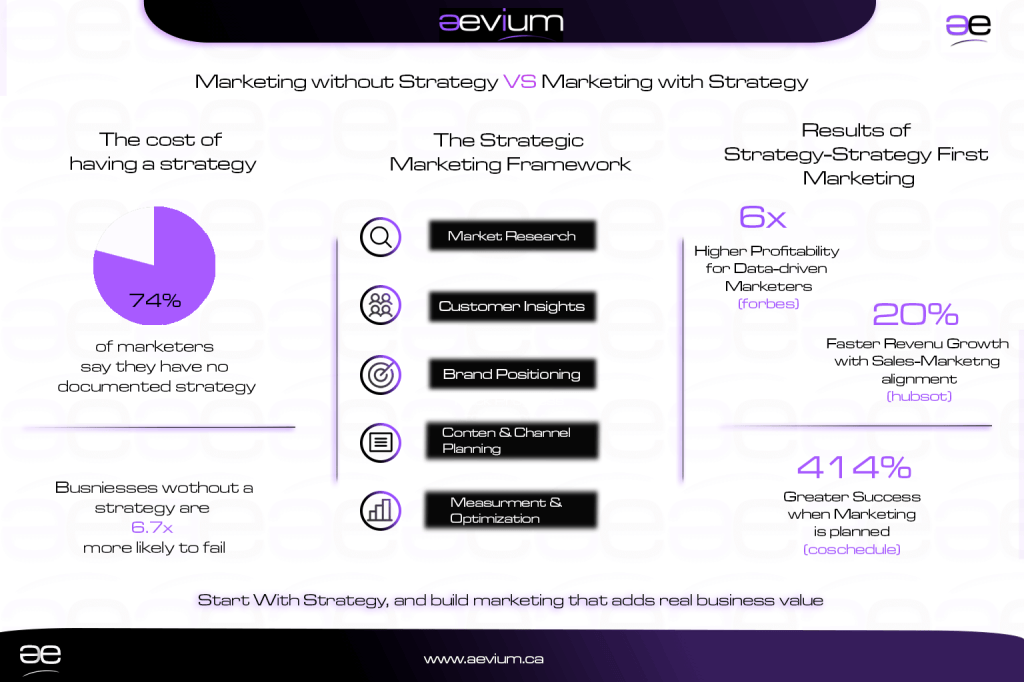
    • Businesses with a documented marketing strategy are 6.7× more likely to report success
      Source: coschedule
    • Documented digital marketing efforts increase success odds by 414% (7× more likely)
      Source: coschedule

    If you’re not building strategy into your marketing, you’re leaving serious money, and momentum, on the table.

    The Bottom Line for SMBs

    Before you boost another post, sign off on a new logo, or hire an agency, pause.

    Ask yourself:

    • Do we really understand who we’re serving?
    • Are we clearly different from our competitors?
    • Are our goals, message, and tactics all working together?

    If you’re not sure, you don’t need more content, you need more clarity.

    Because marketing isn’t just about getting attention. It’s about earning trust and driving business.

    And that only happens when strategy comes first.

    Want to start a Project?

  • Why Most Marketing Strategies Fail (and How to Fix Yours)

    Why Most Marketing Strategies Fail (and How to Fix Yours)

    We get it, claiming most marketing strategies fail sounds harsh. But numbers don’t lie. Keep reading to see what Harvard, McKinsey, and Gartner have found.

    Marketing is one of the most powerful tools a business can use to grow, yet many marketing strategies fall flat. Despite big budgets and well-meaning intentions, companies often find themselves questioning their ROI, struggling to convert leads, or failing to build long-term brand equity.

    But why do so many marketing strategies fail, and what can you do to avoid the same fate?

    Let’s break it down.

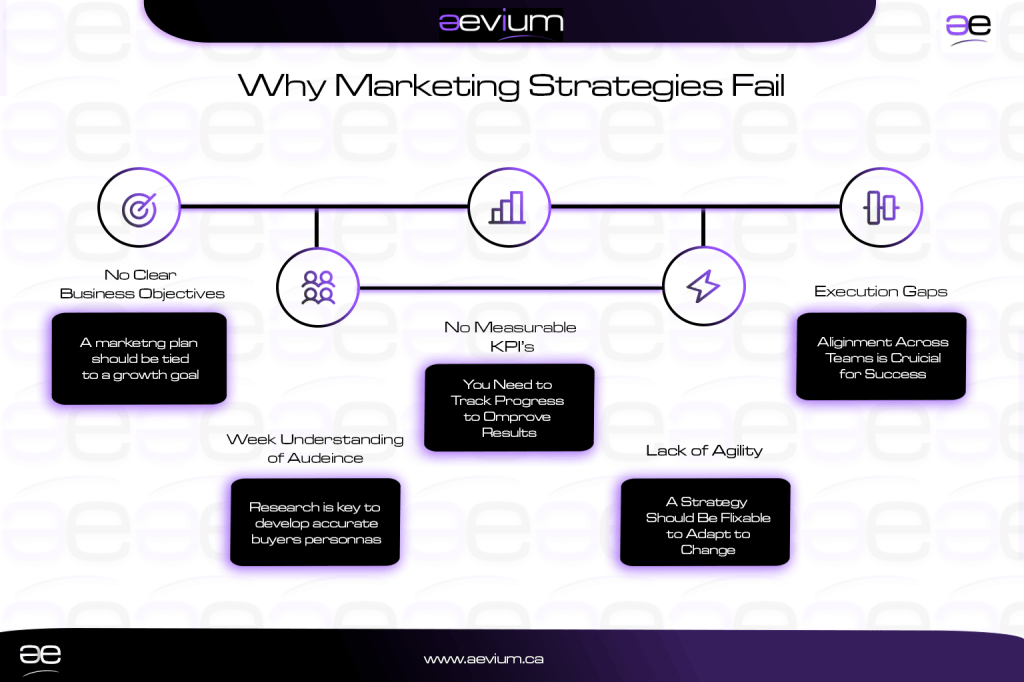
    1. Lack of Clear Objectives

    If you don’t know where you’re going, any road will take you there. Many strategies fail because they don’t define specific, measurable goals upfront.

    Fix: Start with SMART goals: Specific, Measurable, Achievable, Relevant, and Time-bound. Tie them directly to business outcomes, such as lead generation, conversions, or customer lifetime value.

    2. No Real Customer Insight

    Assuming you know your audience is dangerous. Without real customer research, your messaging may miss the mark completely.

    Fix: Use data. Invest in surveys, interviews, social listening, and CRM analytics to shape messaging and targeting based on real behavior and preferences.

    3.Strategy Without Execution (and Vice Versa)

    Even great ideas fall flat if not executed well. And good execution won’t save a poor strategy.

    Fix: Make sure your strategic plan is directly tied to tactics, content calendars, media plans, email automation, and performance metrics. Keep teams aligned and accountable.

    4.Failure to Differentiate

    In crowded markets, playing it safe is the fastest way to become invisible.

    Fix: Find your edge. What do you offer that no one else does? What’s your brand voice, your point of view, your customer promise? Build strategy around that.

    5. Inconsistent Messaging Across Channels

    If your email sounds one way, your Instagram another, and your website another, you’re confusing your audience.

    Fix: Develop a unified messaging framework and brand voice. Make sure everyone from designers to sales knows how to communicate your value consistently.

    6. Poor Measurement & Optimization

    A set-it-and-forget-it approach is a recipe for failure. If you’re not measuring the right KPIs or optimizing based on performance, you’re wasting money.

    Fix: Build dashboards that track what matters. Regularly review performance. Test, learn, and optimize based on data—not guesses.

    Final Thoughts

    In a world obsessed with trends, tools, and tactics, many businesses lose sight of the core of marketing, the Four Ps: Product, Price, Place, and Promotion. These principles aren’t outdated; they’re the foundation of every successful strategy. When they’re not clearly defined or aligned with customer needs, even the most creative campaigns will fall flat.

    Another critical reason strategies fail is the absence of the right people driving them. SMB owners often delegate strategy to generalists or internal teams without the data, research, or experience required to succeed in today’s fast-moving market. Without deep market intelligence, competitor analysis, and customer insight, strategy becomes guesswork, and guesswork is expensive.

    Here’s the hard truth: launching performance and growth campaigns without a solid strategic foundation is like building a house on sand. You might generate views, impressions, clicks, or even short-term conversions, but without alignment to positioning, pricing, messaging, and audience targeting, the results won’t scale, and your budget will bleed.

    To break the cycle, businesses need to shift from a “campaign mindset” to a strategic growth mindset:

    • Build your marketing plan around data, not assumptions.
    • Tie every campaign, from paid media to content, to strategic objectives.
    • Prioritize clarity over complexity: Who is your ideal customer? Why should they choose you?
    • Invest in marketers who think long-term, not just tactically.

    Marketing, when done right, isn’t a cost center; it’s a growth engine. But it only works when it’s rooted in strategic thinking, cross-functional alignment, and consistent execution.

    If your current strategy isn’t delivering results, take a step back. Audit the basics. Revisit the Four Ps. Ask the hard questions. And if needed, bring in experts who can help you turn fragmented efforts into a unified roadmap for scalable success.

    Source Links for

    1- Harvard Business School – 80% of new products fail
    Explains the high failure rate of product launches and the role of poor marketing in these failures.
    link: https://hbr.org/2011/04/why-most-product-launches-fail

    2- Only ~40% of marketers rate their strategy effective
    CoSchedule reports in 2022 that only 11% say their strategy is “very successful,” while the majority say it’s only “somewhat” or worse, and many lack documented plans.
    ink: coschedule.com

    3- 58% of consumers feel misunderstood by brands
    Despite access to data and technology, more than half of consumers believe companies don’t understand their needs—highlighting a major empathy gap in marketing.
    Link: The CDO TIMES+5Gartner+5Business Wire+5

    4- Nearly 40% of marketing budgets go toward transformation and change efforts
    Gartner’s 2025 CMO survey reveals 40%+ of marketing spend is devoted to transformational work rather than execution—underscoring the disconnect between strategy and action.
    Link: Gartner+1Business Wire+1

    5- 70–90% of digital transformation efforts fail
    Recent McKinsey data confirms that up to 90% of digital transformation attempts—including strategic marketing initiatives—fail to reach their goals, often due to poor adoption or lack of leadership alignment.
    Link: Reddit+14theecmconsultant.com+14staging1.outsourceaccelerator.com+14

    6- Only ~12–16% of transformation initiatives achieve lasting results
    According to Bain and EY surveys, most transformation programs don’t deliver sustained impact—with only about 12% considered long-term successes.
    Link: The CDO TIMES

    Want to start a Project?

  • Adobe Just Launched 10 AI Marketing Agents, Here’s What SMB’s Need to Know

    Adobe Just Launched 10 AI Marketing Agents, Here’s What SMB’s Need to Know

    In a move that’s shaking up the entire marketing industry, Adobe just introduced 10 AI-powered agents built to handle everything from campaign planning to content creation, data analysis, and customer journey orchestration.

    If you’re running a business in 2025, whether you’re a solo founder, a growing startup, or a local brand, this news isn’t just interesting. It’s a sign of where everything is going.

    Here’s what happened, and why it matters to you.

    Watch the Announcement

    Watch Adobe’s official announcement video below to see the agents in action.

    These AI agents are designed to integrate with tools like Microsoft Copilot and help brands create multilingual content, manage real-time workflows, and optimize marketing strategies at scale. — Source: Adobe

    What Did Adobe Just Launch?

    Adobe’s new “AI agents” are part of its Experience Platform Agent Orchestrator, a system that lets marketers assign complex tasks to AI systems trained on brand-specific data.

    These agents are already helping global brands like Coca-Cola and Marriott:

    • Analyze large volumes of campaign data
    • Optimize customer journeys in real time
    • Generate personalized, multilingual content
    • Plan and execute cross-channel campaigns
    • Integrate with external systems like CRMs, social, and paid media platforms

    They’re also launching Brand Concierge, a voice + text AI that can generate messaging, creative ideas, and CX recommendations on demand.

    Why This Is Bigger Than Just Enterprise Tech

    At first glance, this sounds like big-brand stuff. But here’s what we’re seeing at Aevium:

    The same core technology powering Adobe’s AI agents is already accessible to SMB’s, through tools like Zapier, Make.com, n8n, and custom GPT workflows.

    What Adobe is doing validates what we’ve been building with Aevium Flow: AI-enhanced automation systems that give smaller teams the same kind of speed, consistency, and scale that the big players enjoy.

    What Small Businesses Can Learn (and Do) Now

    AI agents are your future team members
    If Adobe is any indicator, AI agents will soon be running workflows in content, email, social, analytics, and sales enablement , even at the SMB level.

    You don’t need Adobe’s tech to get started
    With platforms like Make.com and Zapier, you can already deploy your own AI-lite automations: email follow-ups, CRM syncs, social posting, lead routing, chatbots, and more.

    You need a strategy before tools
    The businesses winning with automation aren’t just “using AI.” They’ve mapped their workflows, defined objectives, and built processes that scale.

    Aevium’s Take

    At Aevium, we’re obsessed with automation, but not just for the tech.

    We believe in freeing up human creativity by automating the repetitive stuff. Whether it’s your lead capture flow, onboarding emails, booking confirmations, or campaign analytics, you can delegate it to an automation system and focus on the parts of your business that truly move the needle.

    Adobe just confirmed what we already knew:

    Automation is no longer just a productivity hack. It’s a strategic lever.

    And the future? It’s already here.

    Want to Build Your Own AI Agent?

    We’re helping small and medium-sized businesses build custom automation stacks using tools like:

    • Make.com
    • Zapier
    • n8n
    • Airtable
    • ChatGPT (custom agents)
    • Voiceflow
    • Calendly, Stripe, HubSpot, and more

    Want to see what this could look like for your business?

    Book a discovery call?

  • Why Fractional CMO Services Are the Growth Engine SMBs Have Been Missing

    Why Fractional CMO Services Are the Growth Engine SMBs Have Been Missing

    Most small and medium-sized businesses (SMBs) hit a growth ceiling, not due to lack of ambition or great products, but sometimes due to the absence of strategic marketing leadership.

    Hiring a full-time Chief Marketing Officer (CMO) is expensive to say the least, and often out of reach for businesses that are still scaling. But without strategic oversight, marketing becomes a patchwork of disconnected tactics, leading to wasted spend, missed opportunities, and slow growth.

    This is where Fractional CMO services step in, and where Aevium delivers real impact.

    What Is a Fractional CMO?

    A Fractional CMO is a seasoned marketing executive who works with your business part-time or on a project basis. They bring the same strategic thinking and leadership as a full-time CMO, but without the hefty salary or long-term commitment.

    At Aevium, our Fractional CMOs become an extension of your leadership team, guiding your marketing strategy, managing vendors or teams, and aligning marketing with business outcomes.

    Why SMBs Need Fractional CMO Services

    1. Strategic Direction Without Full-Time Overhead

    A fractional CMO gives you access to expert marketing leadership for a fraction of the cost. You get the strategy, systems, and decision-making without paying a six-figure salary.

    2. Faster, Smarter Growth

    Instead of trial-and-error marketing, a fractional CMO builds a clear roadmap with measurable KPIs, smart targeting, and scalable campaigns, accelerating your time to results

    3. Better Marketing ROI

    With an experienced strategist steering the ship, your marketing budget is used efficiently. No more random spending on social ads or one-off campaigns with no follow-through.

    4. Team Leadership & Vendor Management

    Already working with freelancers, agencies, or an in-house team? A fractional CMO ensures everyone is aligned and accountable, so you get better outcomes from every dollar and every hour.

    5. Adaptability for Every Stage of Growth

    Whether you’re launching a new product, entering a new market, or preparing for funding, our fractional CMOs adapt the strategy to meet your specific stage and business goals.

    What Fractional CMO Services Include at Aevium

    At Aevium, we tailor every engagement to your business needs. Our typical Fractional CMO scope of services includes:

    • Marketing Audits & Gap Analysis
    • Marketing Strategy Development
    • Brand Positioning & Messaging
    • Campaign Planning & Execution Oversight
    • Vendor & Team Management
    • Performance Tracking & Optimization
    • Investor/Stakeholder Communication Support

    We act not just as consultants, but as accountable leaders, delivering measurable business value.

    Who Is This Right For?

    • SMBs spending $3K–$50K/month on marketing and not seeing ROI
    • Founders wearing too many hats and needing senior-level guidance
    • Startups prepping for funding or expansion
    • Companies shifting from tactical to strategic marketing

    Need help with marketing automation or improving customer communication? We can integrate that too.

    Why Aevium?

    We’re more than just marketers, we’re growth partners. Our Fractional CMOs are backed by a full multidisciplinary agency, giving you access to implementation resources in digital marketing, automation, web, and content, so strategy becomes execution, fast.

    And because we specialize in working with Canadian SMBs across industries like real estate, SaaS, and local services, we understand what it takes to win in today’s fast-moving, AI-driven market.

    Ready to Take Your Marketing from Tactics to Strategy?

    If you’re tired of playing small with your marketing, or just want a trusted advisor in your corner, our Fractional CMO service might be the catalyst your business needs.

    Book a free strategy consultation and find out how we can help you grow smarter and faster.

  • Re-imagining SMB’s: Why We Launched Aevium

    Re-imagining SMB’s: Why We Launched Aevium

    Small and medium businesses (SMBs) are the backbone of every community. In today’s digital age, they’re expected to do more with less. At Aevium, we believe the same tools transforming global enterprises should also be available to the barbershop around the corner, the family-run clinic, or the local real estate office. That’s why we launched Aevium, to help small businesses grow, compete, and thrive using innovative AI-powered solutions and strategic digital marketing.

    Leveling the Playing Field with AI

    AI isn’t just a buzzword, it’s a business advantage. From automating repetitive tasks to improving customer interactions and optimizing operations, we design practical, intelligent tools that work in the background so owners can focus on what matters: growing their business. Think AI voice receptionists, smart CRM workflows, and personalized customer journeys, all built to make everyday business smoother, faster, and smarter.

    Local Marketing That Delivers

    Beyond automation, we help businesses stand out where it counts, in their own communities. Our hyper-local marketing strategies and local search optimization tactics ensure your brand is found, chosen, and remembered by the people closest to you. It’s not just about visibility, it’s about relevance and trust in an increasingly competitive digital landscape.

    A Vision for Canada’s Small Business Future

    What started in Kitchener is just the beginning. Our mission is national: to build a future where every small business in Canada, regardless of size or budget, has access to the same transformative technologies as the giants. We’re not here to replace the human touch. We’re here to enhance it with smart systems that empower business owners, elevate customer experience, and unlock sustainable growth.

    If you’re ready to re-imagine what your business could be, let’s talk.

    Welcome to Aevium.

  • Hello World!

    Welcome to WordPress! This is your first post. Edit or delete it to take the first step in your blogging journey.