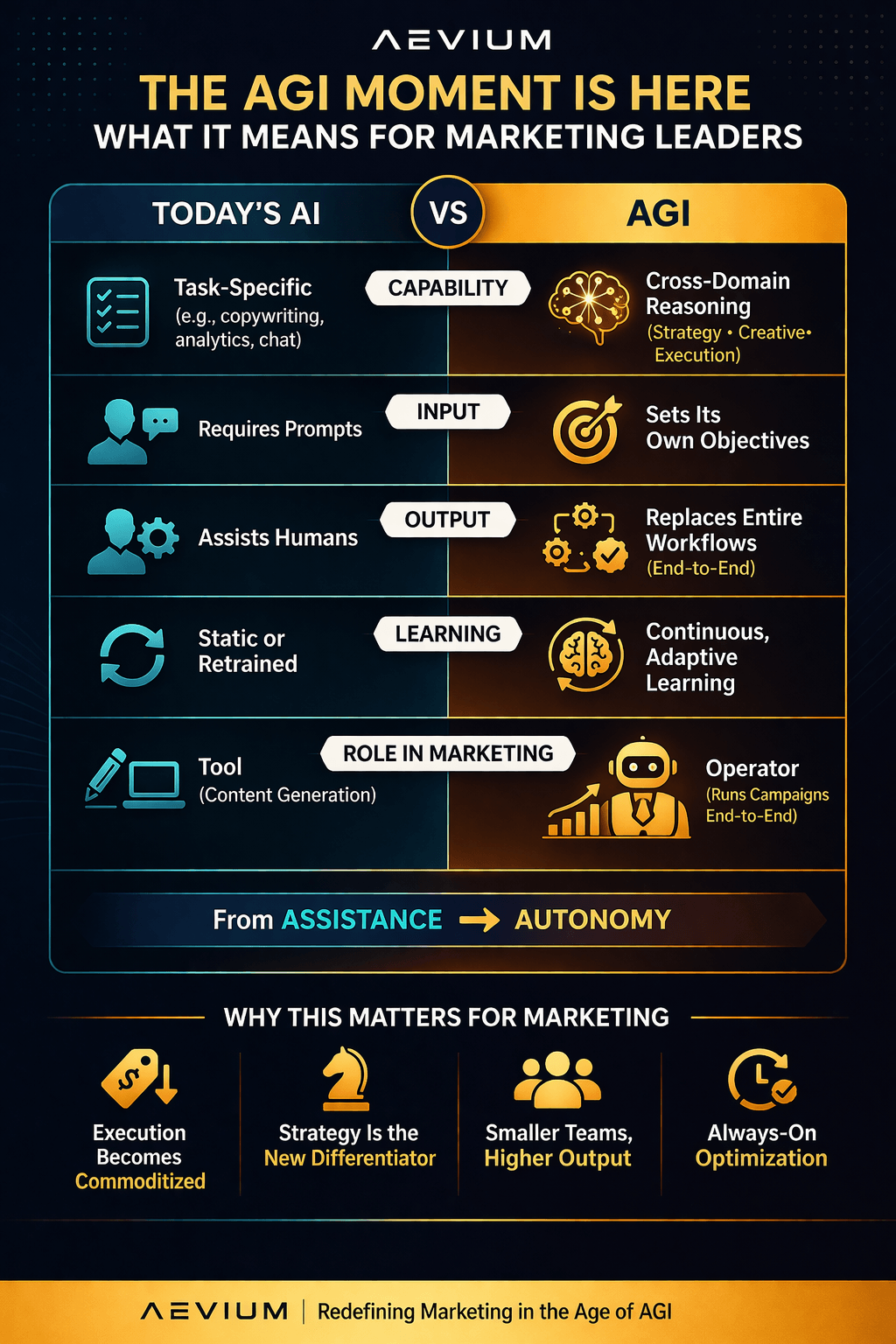
Artificial General Intelligence is no longer a distant concept. For years, AGI was positioned as something on the horizon, a future milestone that businesses could afford to watch rather than prepare for. Today, that framing is beginning to shift, and the conversation around AGI in marketing is becoming more immediate.
When Jensen Huang, CEO of NVIDIA, suggested that we may have already reached a form of AGI, it did more than spark debate. It signaled a change in urgency. Whether or not one agrees with that definition, the implication is clear. Artificial intelligence is no longer just improving tools. It is starting to reshape how work itself is executed.
From AI Tools to Autonomous Systems
Up until now, AI has primarily functioned as an enabler. It has accelerated execution, reduced costs, and improved efficiency, but it has remained dependent on human direction. The responsibility for thinking, judgment, and orchestration has stayed with people.
That boundary is now being tested.
We are entering a phase where AI systems are beginning to move beyond task execution into reasoning. These systems can connect information across domains, make decisions, and carry initiatives forward with limited oversight. This transition from assistance to autonomy has significant implications for marketing as a discipline and reinforces why AGI in marketing is becoming a critical focus.
The Impact of AGI in Marketing on Agencies
For marketing agencies, the shift is structural. Execution, which has traditionally been a core revenue driver, is becoming increasingly automated. As a result, its perceived value is declining. At the same time, strategic thinking is becoming more critical.
Positioning, market understanding, and the ability to define the right problems are emerging as the primary sources of differentiation.
This evolution will likely reshape agency models. Smaller, more focused teams will be able to deliver greater output by leveraging AI-driven workflows. The gap between organizations that understand how to integrate these systems effectively and those that do not will widen. Agencies will move closer to business strategy, playing a more central role in decision-making rather than focusing primarily on campaign execution.
How AGI in Marketing Is Changing Client Expectations
Clients are undergoing a similar transformation. As AI capabilities become more accessible, internal teams are gaining the ability to take on work that was previously outsourced. Expectations around speed and responsiveness are increasing, and traditional timelines are being compressed.
What once felt fast will soon feel slow.
In parallel, data is becoming an even more important competitive asset. The effectiveness of AI systems will depend heavily on the quality and structure of the data they are built on. This is where AGI in marketing will create the biggest divide between organizations.
Decision-making processes are also evolving. As AI systems become more capable, they are starting to influence not only execution but also optimization and strategic choices. Budget allocation, channel selection, and performance optimization are increasingly informed by AI-driven insights. This does not eliminate the need for human judgment, but it does redefine where that judgment adds the most value.
The more relevant question for marketing leaders is no longer how to use AI tools.
It is how to operate in an environment where execution is no longer the primary constraint.
Artificial General Intelligence, whether fully realized or still developing, is already influencing expectations across the industry. In marketing, expectations directly impact perceived value, pricing models, and competitive positioning.
Organizations that adapt successfully will not be those that simply adopt new technologies. They will be the ones that rethink their operating models, redefine their value proposition, and align their capabilities with a more autonomous, AI-driven landscape.
That shift is already underway.
The impact of AGI in marketing is only beginning, and those who adapt early will define what comes next.
If you’ve read this far, I’m curious where you stand on this.
Do you believe AGI is already here, or are we still early?
And more importantly, how are you thinking about your role as this shift unfolds?
Curious to hear your perspective. If this resonated, feel free to like or share so more people in the industry can weigh in.


Leave a Reply